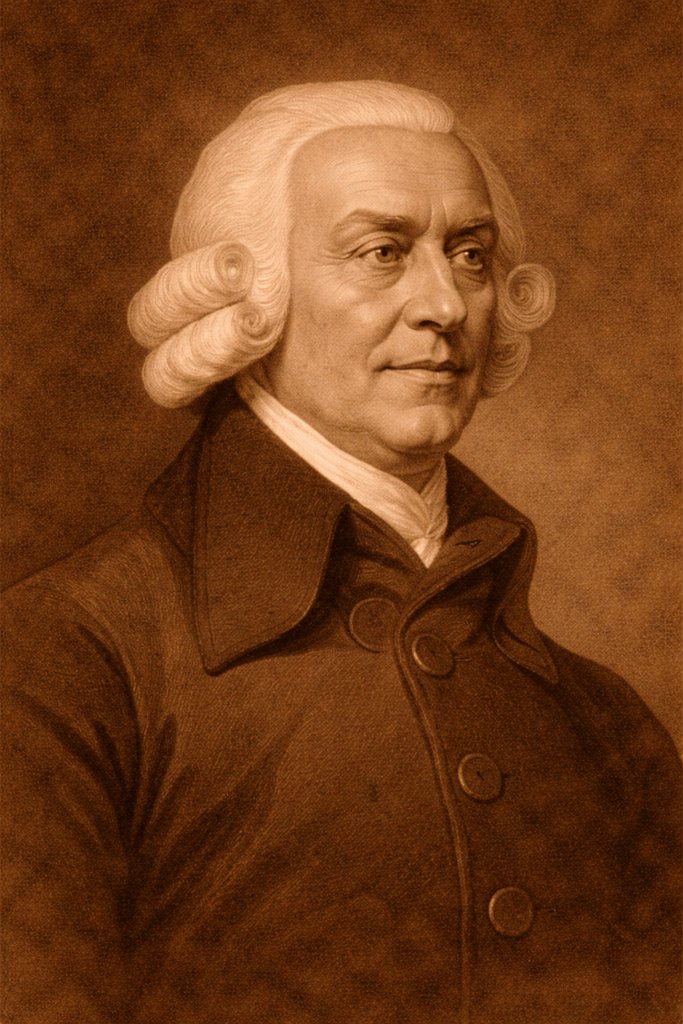
Adam Smith
Biography
Adam Smith (1723–1790) was a Scottish economist, philosopher, and author widely regarded as the father of modern economics. Born in Kirkcaldy, Scotland, he studied at the University of Glasgow and Balliol College, Oxford. Smith held the chair of moral philosophy at Glasgow, where he developed his theories on human sympathy and ethical judgment. His first major work, The Theory of Moral Sentiments (1759), explored the psychological foundations of morality. His magnum opus, An Inquiry into the Nature and Causes of the Wealth of Nations (1776), laid the groundwork for classical economics and free-market theory. Smith’s concepts of the invisible hand, division of labor, and self-interest as an engine of prosperity became cornerstones of economic thought. He served as Commissioner of Customs in Scotland from 1778 until his death.
Common themes in Adam Smith's work
Classical economics
A recurring theme throughout Adam Smith's writing.
Free market theory
A recurring theme throughout Adam Smith's writing.
Moral philosophy
A recurring theme throughout Adam Smith's writing.
The invisible hand
A recurring theme throughout Adam Smith's writing.
Books

Explore by genre
Other authors you may enjoy
Why Adam Smith is still read today
Adam Smith’s ideas remain foundational to modern economics, trade policy, and debates about capitalism versus regulation. The Wealth of Nations is still required reading in economics programs worldwide. His moral philosophy offers a counterbalance to purely materialist interpretations of his economic work.
Frequently Asked Questions
Who was Adam Smith?
Adam Smith (1723–1790) was a Scottish philosopher and economist, best known as the author of The Wealth of Nations. He is considered the father of modern economics.
What are Adam Smith’s most famous works?
His two major works are The Theory of Moral Sentiments (1759) and The Wealth of Nations (1776). Both are available to read free on TextStack.
What is the invisible hand?
The invisible hand is Smith’s metaphor for the way individual self-interest in a free market can lead to positive outcomes for society as a whole.
Where can I read Adam Smith online for free?
You can read The Wealth of Nations and The Theory of Moral Sentiments for free on TextStack.
Essential cookies keep you signed in and save your reading progress. Analytics cookies help us understand how the site is used. You can reject analytics — we still work without them. Learn more in our Privacy Policy.