Plato
Biography
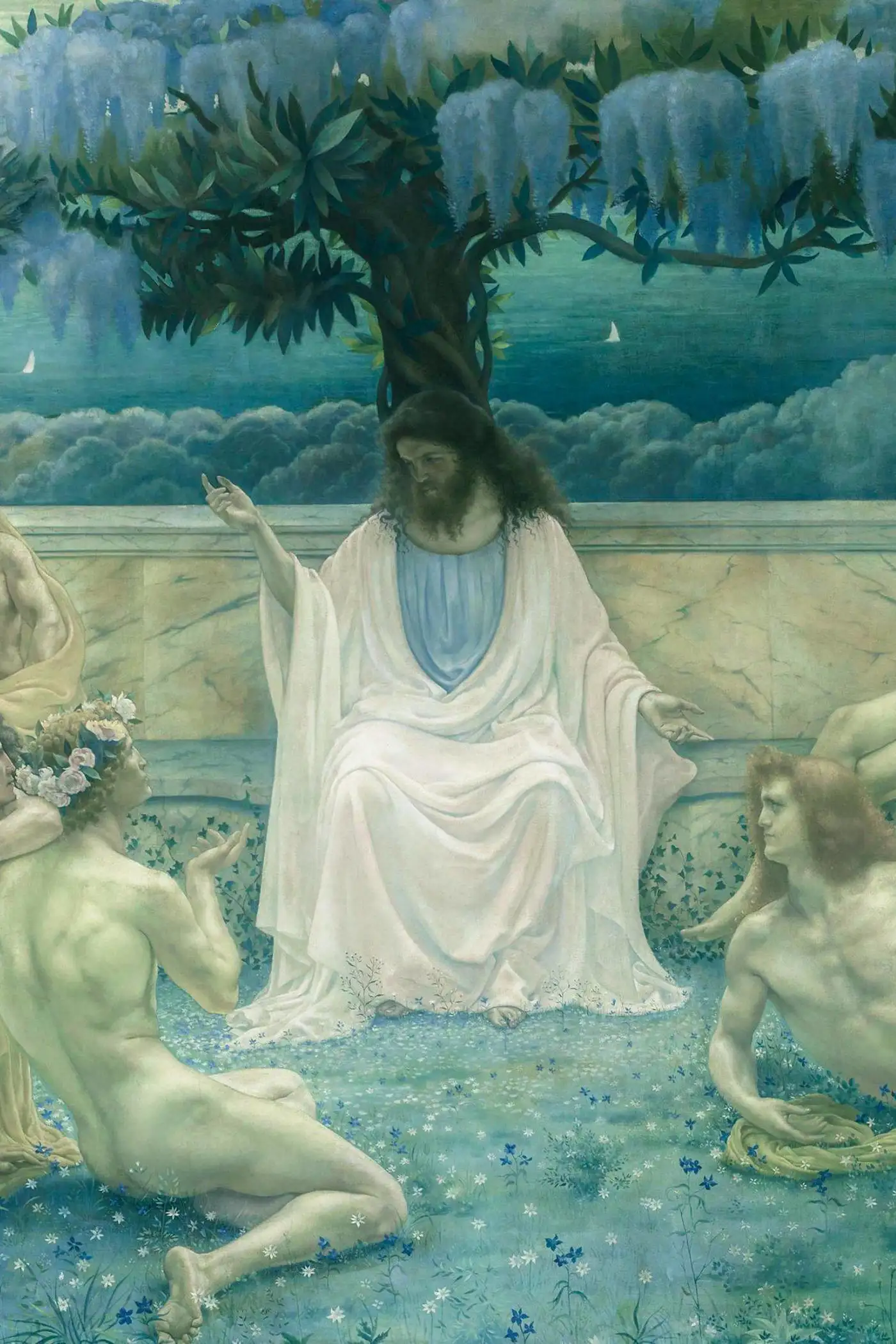
Plato (c. 428–c. 348 BC) was an ancient Greek philosopher who is widely considered the most important figure in the history of Western philosophy. Born in Athens to an aristocratic family, Plato became a devoted student of Socrates, whose execution in 399 BC profoundly shaped his life and thought. Around 387 BC Plato founded the Academy in Athens, one of the first institutions of higher learning in the Western world, which continued for nearly nine centuries. His philosophical works, written as dialogues featuring Socrates as the principal speaker, explore virtually every major philosophical question: justice, beauty, truth, knowledge, reality, language, mathematics, politics, ethics, and the nature of the soul. Among the most celebrated dialogues are the Republic (on justice and the ideal state), the Symposium (on love), the Phaedrus (on beauty and rhetoric), the Phaedo (on the immortality of the soul), the Apology (Socrates’ defense at trial), and the Timaeus (on cosmology). Plato’s Theory of Forms—the idea that the material world is a shadow of a higher realm of perfect, unchanging Ideas—has been one of the most influential philosophical concepts in Western history. Alfred North Whitehead famously characterized all of Western philosophy as "a series of footnotes to Plato."
Common themes in Plato's work
Western Philosophy
A recurring theme throughout Plato's writing.
Theory of Forms
A recurring theme throughout Plato's writing.
Justice and Politics
A recurring theme throughout Plato's writing.
Socratic Dialogue
A recurring theme throughout Plato's writing.
Books
Explore by genre
Other authors you may enjoy
Why Plato is still read today
Plato’s influence on Western thought is unparalleled. His ideas about justice, knowledge, beauty, and the nature of reality continue to shape philosophy, political theory, education, and theology. Every significant intellectual tradition in the West engages with Plato, making his dialogues essential reading for understanding human thought.
Frequently Asked Questions
Who was Plato?
Plato was the most influential philosopher in Western history, whose dialogues explore justice, knowledge, beauty, reality, and the nature of the soul. Read his Dialogues free on TextStack.
What is the Theory of Forms?
Plato argued that the material world is a shadow of a higher realm of perfect, unchanging Ideas (Forms)—the true reality behind appearances.
Why are Plato’s works written as dialogues?
The dialogue form dramatizes philosophical inquiry as conversation, showing how ideas are tested and refined through questioning—reflecting Socrates’ method of teaching.
Where can I read Plato?
You can read Plato’s Dialogues for free on TextStack—the foundational texts of Western philosophy.
Essential cookies keep you signed in and save your reading progress. Analytics cookies help us understand how the site is used. You can reject analytics — we still work without them. Learn more in our Privacy Policy.