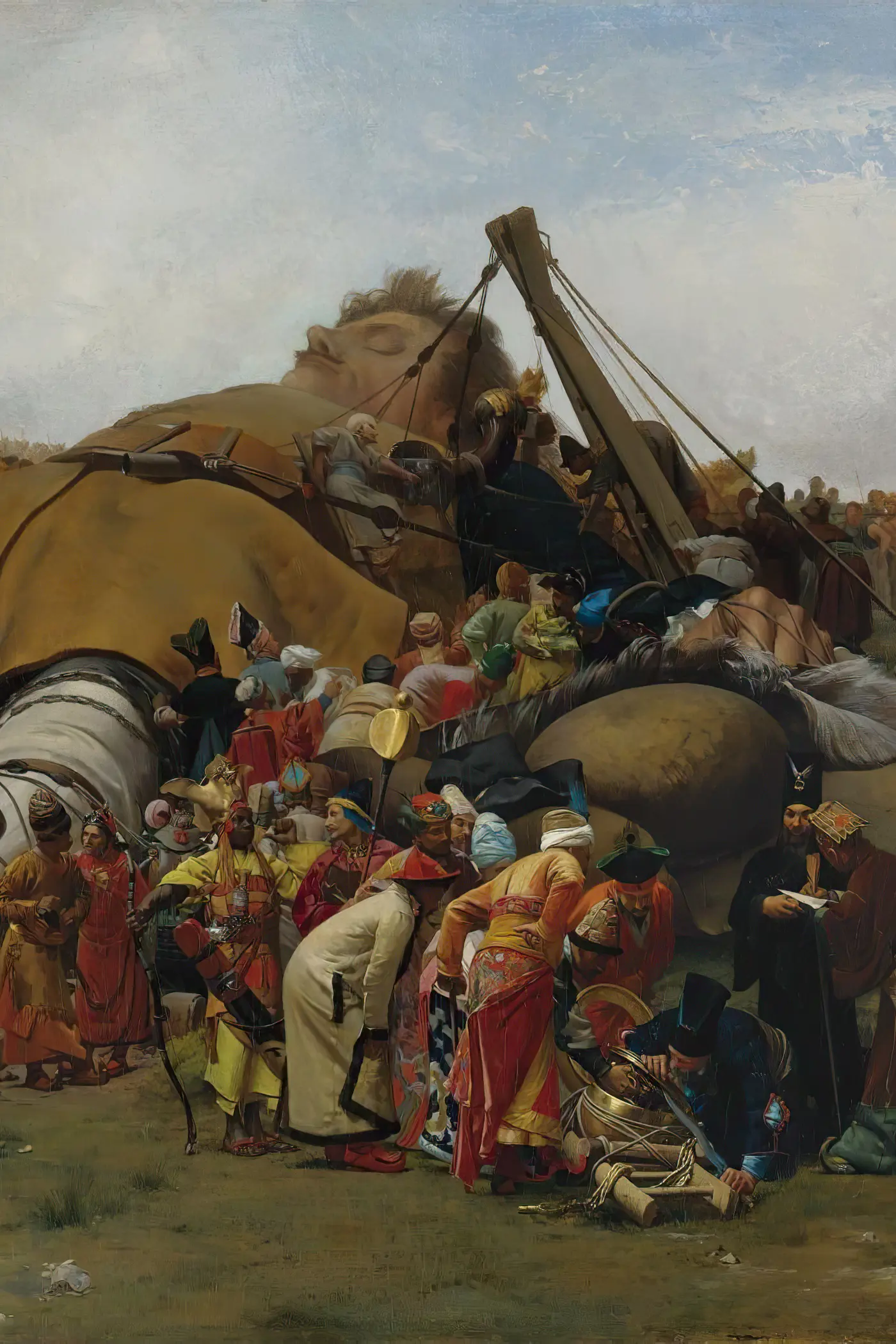
Gulliver's Travels
What is Gulliver's Travels about?
Gulliver's Travels by Jonathan Swift is a brilliant satirical masterpiece that uses fantastical voyages to critique human nature and 18th-century society. Published in 1726, this classic follows ship surgeon Lemuel Gulliver through four extraordinary journeys: to Lilliput where he towers over tiny inhabitants, to Brobdingnag where he becomes the miniature curiosity, to the flying island of Laputa, and finally to the land of the rational Houyhnhnms. Swift's biting wit exposes political corruption, scientific folly, and the absurdities of human behavior. More than a children's adventure, this enduring work of English literature offers profound commentary that remains startlingly relevant today.
Main themes in Gulliver's Travels
Satire of human nature
In Gulliver's Travels, satire of human nature provides a lens for understanding the story's core message.
Politics and corruption
The presence of politics and corruption in Gulliver's Travels connects readers to its enduring relevance.
Perspective and relativity
The presence of perspective and relativity in Gulliver's Travels connects readers to its enduring relevance.
Reason vs. passion
The presence of reason vs. passion in Gulliver's Travels connects readers to its enduring relevance.
Why Gulliver's Travels is still relevant today
Gulliver's Travels is the supreme satire in English literature, Jonathan Swift's fantastical voyages masking devastating critiques of human nature, politics, and society. Though often adapted as children's literature, the original is sophisticated adult satire whose irony remains sharp nearly 300 years later. The novel's examination of perspective, power, and the human capacity for self-deception speaks directly to our era of political polarization and media manipulation. Swift created enduring images—Lilliputians, Brobdingnagians, Yahoos—that have entered cultural consciousness.
Frequently Asked Questions
Is Gulliver's Travels a children's book?
While often adapted for children, the original is sophisticated adult satire. Swift uses fantasy to critique politics, science, and human nature with sometimes disturbing conclusions. The full text contains irony and dark humor inappropriate for young readers.
What are the four voyages?
Gulliver visits: Lilliput (tiny people satirizing petty politics), Brobdingnag (giants revealing human insignificance), Laputa and others (critiquing impractical intellectuals), and the Houyhnhnms (rational horses showing humanity's Yahoo nature).
What is Swift really criticizing?
Swift targets political factionalism (Lilliput), human pride (Brobdingnag), detached intellectualism (Laputa), and ultimately human nature itself (Houyhnhnms). The satire encompasses politics, science, colonialism, and the gap between human pretension and behavior.
Who or what are Yahoos?
In the fourth voyage, Yahoos are brutish humans ruled by rational horses (Houyhnhnms). Gulliver realizes he himself is a Yahoo. Swift suggests that stripped of pretension, humans are irrational, violent animals. The comparison deliberately disturbs.
Why is Gulliver's Travels still relevant?
Swift's insights about political tribalism, intellectual arrogance, and human self-deception remain startlingly applicable. In an era of partisan media and declining trust, his examination of how people rationalize their worst behaviors feels prophetic.