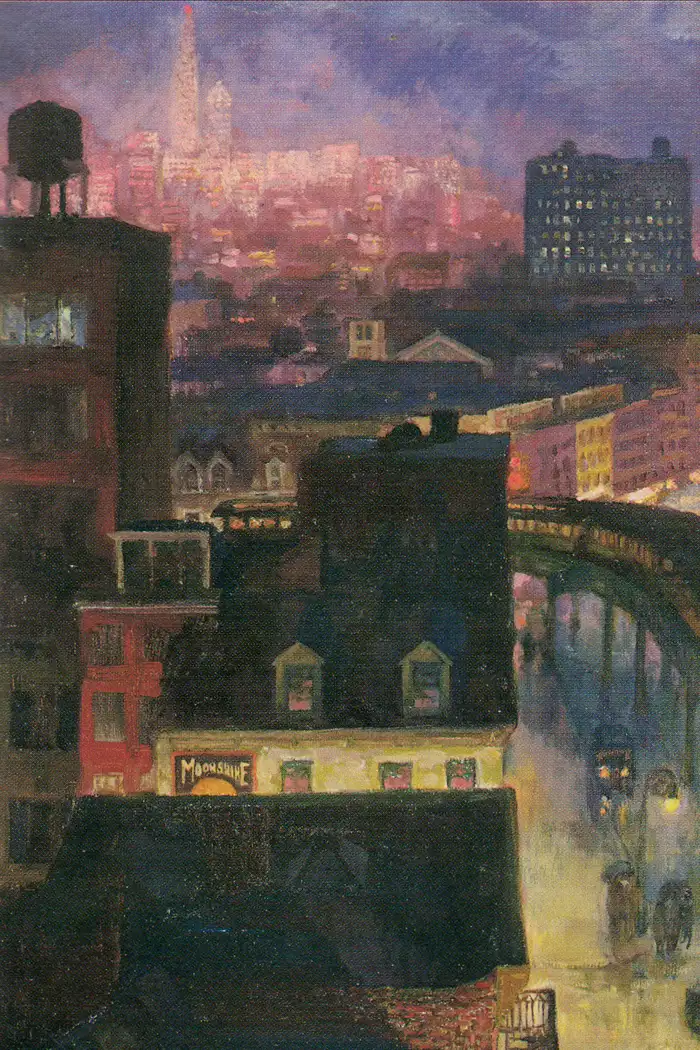
Manhattan Transfer
What is Manhattan Transfer about?
Manhattan Transfer (1925) is John Dos Passos’s groundbreaking experimental novel, a kaleidoscopic portrait of New York City in the early twentieth century. Rather than following a single protagonist, the novel weaves together dozens of characters—immigrants, showgirls, lawyers, sailors, journalists, and con men—whose stories intersect and diverge across the relentless landscape of the city. Dos Passos’s technique is cinematographic: rapid scene changes, fragmented narratives, and impressionistic prose create the sensation of urban life in all its speed, noise, and overwhelming multiplicity. The novel traces its characters through the decades from the 1890s to the 1920s, capturing the transformation of New York into the modern metropolis—its immigrant waves, its building booms, its economic cycles of boom and bust, and its ruthless capacity to elevate and destroy human hopes. Manhattan Transfer pioneered narrative techniques that Dos Passos would develop further in the U.S.A. trilogy, and its influence can be traced through Alfred Döblin’s Berlin Alexanderplatz to contemporary multi-perspective urban fiction.
Main themes in Manhattan Transfer
Urban modernism
Manhattan Transfer thoughtfully explores urban modernism through its central conflicts.
New York City panorama
The presence of new york city panorama in Manhattan Transfer connects readers to its enduring relevance.
Kaleidoscopic narrative
The theme of kaleidoscopic narrative weaves through Manhattan Transfer, adding depth to its narrative.
Immigration
The theme of immigration weaves through Manhattan Transfer, adding depth to its narrative.
Why Manhattan Transfer is still relevant today
Manhattan Transfer is a landmark of American modernism whose kaleidoscopic technique captures the energy, chaos, and human cost of urban life with unprecedented power. Its innovative narrative methods influenced generations of writers and remain influential in contemporary fiction.
Frequently Asked Questions
What is Manhattan Transfer about?
A kaleidoscopic novel weaving together dozens of characters across decades of New York City life, capturing the energy, chaos, and human cost of the modern metropolis.
Is Manhattan Transfer difficult to read?
Its fragmented, multi-character structure requires adjustment, but the vivid scenes and cinematic pacing make it an exhilarating reading experience.
Can I read it online for free?
Yes, read Manhattan Transfer for free on TextStack with a comfortable reading experience.