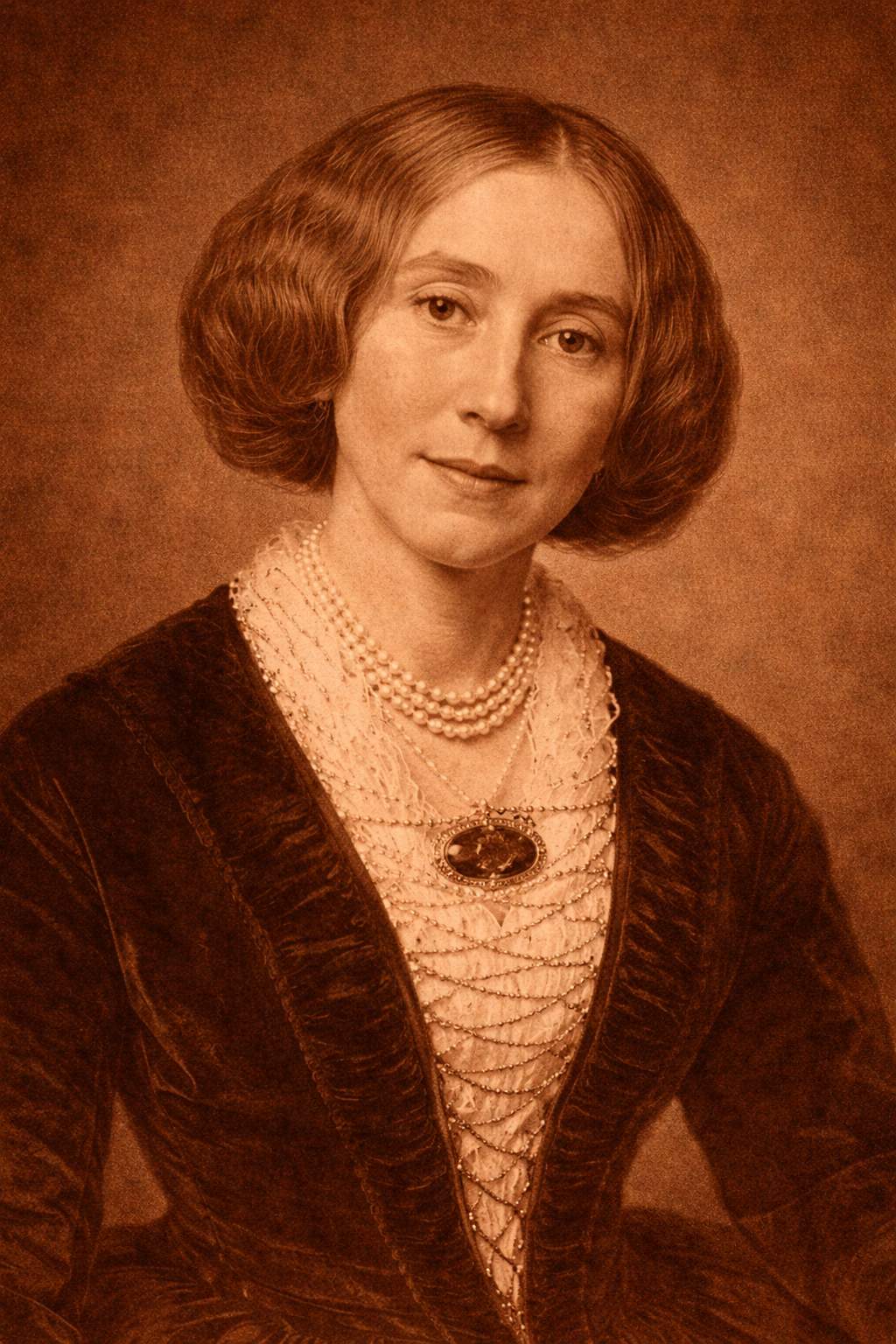
George Eliot
Biography
George Eliot was the pen name of Mary Ann Evans (1819–1880), an English novelist, poet, and essayist who produced some of the most psychologically penetrating fiction of the Victorian era. Born in Nuneaton, Warwickshire, she received an education unusual for women of her time, studying languages, philosophy, and theology. Her early intellectual development was shaped by her work as assistant editor of the Westminster Review, a leading progressive journal, where she encountered the ideas of Auguste Comte, Ludwig Feuerbach, and other continental thinkers. Evans adopted the male pseudonym George Eliot in 1857 to ensure her fiction would be taken seriously and to separate her literary work from her personal life, which was considered scandalous due to her long-term relationship with the married writer George Henry Lewes. Her first work of fiction, Scenes of Clerical Life (1857), demonstrated the precise social observation and moral seriousness that would characterize her novels. Eliot's major novels — Adam Bede (1859), The Mill on the Floss (1860), Silas Marner (1861), Middlemarch (1871–1872), and Daniel Deronda (1876) — are distinguished by their intellectual range, detailed depiction of English provincial society, and exploration of moral choice under social constraint. Middlemarch, structured as a multi-plot narrative examining the intersecting lives of characters in a fictional Midlands town, is frequently cited as one of the finest novels in the English language. Its treatment of idealism, marriage, vocation, and political reform set a standard for the realist novel. Eliot's narrative method combined omniscient commentary with close psychological analysis, anticipating developments in the novel form that would emerge in the twentieth century. Her insistence on depicting ordinary life with moral gravity and her refusal to simplify human motivation influenced subsequent novelists including Henry James and Marcel Proust.
Common themes in George Eliot's work
Provincial English life
A recurring theme throughout George Eliot's writing.
Moral growth and sympathy
A recurring theme throughout George Eliot's writing.
Women's limitations
A recurring theme throughout George Eliot's writing.
Religious doubt
A recurring theme throughout George Eliot's writing.
Books
Explore by genre
Other authors you may enjoy
Why George Eliot is still read today
George Eliot (1819-1880), the pen name of Mary Ann Evans, is considered one of the greatest English novelists. Her masterpiece "Middlemarch" is frequently named the greatest English novel, while works like "Silas Marner" and "The Mill on the Floss" combine psychological depth with moral seriousness rare in Victorian fiction. Writing as a man to be taken seriously, Eliot brought philosophical rigor and compassionate understanding to her portraits of provincial life. Her novels explore sympathy, moral growth, and the complex web of social relationships with an intelligence that anticipated modern psychological fiction.
Frequently Asked Questions
Why did Mary Ann Evans write as George Eliot?
She used a male pseudonym to ensure her work was taken seriously and to distance her novels from her unconventional life—she lived openly with a married man, George Henry Lewes. The name also separated fiction from her earlier work as an essayist.
What is George Eliot's best novel?
Middlemarch is usually considered her masterpiece and frequently called the greatest English novel. Its comprehensive portrait of provincial life, psychological depth, and moral insight represent Victorian fiction at its height.
What makes Eliot's novels distinctive?
Eliot brought intellectual depth and philosophical seriousness to the novel. Her psychological insight, moral complexity, and compassionate understanding of human weakness distinguish her from more sensational Victorian novelists.
Was George Eliot controversial?
Her personal life was scandalous—she lived for decades with a married man and later married a man twenty years her junior. Her novels' religious skepticism also troubled some readers, though her reputation remained high.
Where should I start with George Eliot?
Silas Marner is shortest and most accessible. The Mill on the Floss combines accessibility with greater depth. Middlemarch is the masterpiece but longer and denser—best approached with some familiarity with Victorian fiction.
Essential cookies keep you signed in and save your reading progress. Analytics cookies help us understand how the site is used. You can reject analytics — we still work without them. Learn more in our Privacy Policy.