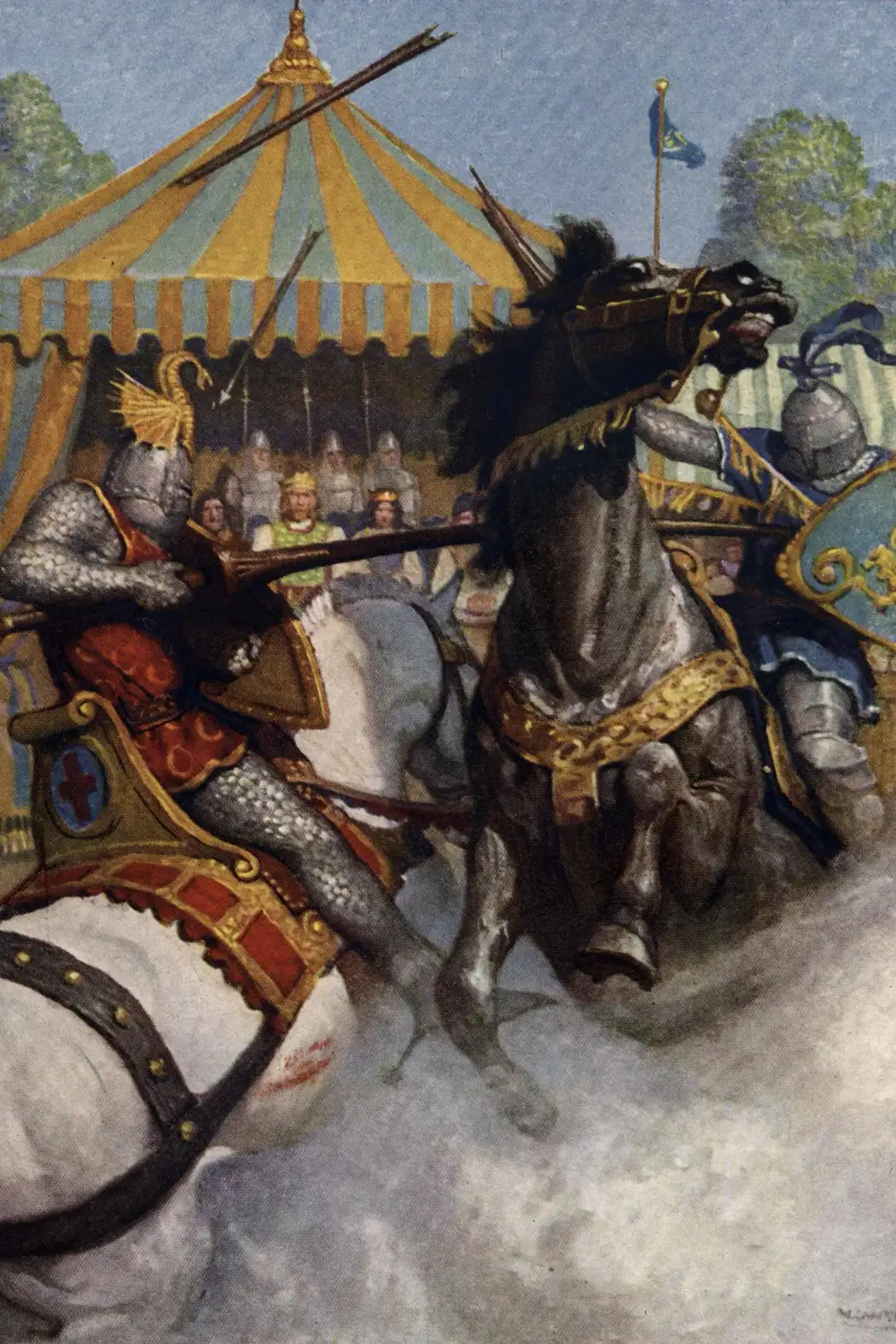
A Connecticut Yankee in King Arthur’s Court
What is A Connecticut Yankee in King Arthur’s Court about?
A Connecticut Yankee in King Arthur’s Court is one of Mark Twain’s most enduring novels. During a stay at a modern-day English castle, the narrator meets a mysterious stranger. The stranger, Hank Morgan, is an engineer from Connecticut, and proceeds to weave a satirical, biting, and hilarious tale of how he traveled back in time to find himself in the court of the legendary King Arthur. There he uses his modern-day knowledge to convince the locals that he’s a powerful magician. As the book progresses, Hank modernizes—and Americanizes—the lives of the locals. Twain’s talent for humor and satire are on full display in Yankee , and he doesn’t waste the opportunity to use Hank as a mouthpiece for his views on things like politics, capitalism, and justice. Many consider it to be his best work.
Main themes in A Connecticut Yankee in King Arthur’s Court
Progress and technology
Progress and technology emerges as a defining element in A Connecticut Yankee in King Arthur’s Court, shaping character development.
Democracy versus aristocracy
The presence of democracy versus aristocracy in A Connecticut Yankee in King Arthur’s Court connects readers to its enduring relevance.
Past versus present
The presence of past versus present in A Connecticut Yankee in King Arthur’s Court connects readers to its enduring relevance.
Power and corruption
A Connecticut Yankee in King Arthur’s Court thoughtfully explores power and corruption through its central conflicts.
Why A Connecticut Yankee in King Arthur’s Court is still relevant today
A Connecticut Yankee in King Arthur's Court pioneered the time-travel genre and remains a sharp satire of both medieval superstition and modern industrial arrogance. The novel critiques the romanticization of the past while questioning whether technological progress equals moral progress. Its dark ending, with mass slaughter by machine guns, anticipates twentieth-century warfare.
More by this author

Frequently Asked Questions
What is A Connecticut Yankee in King Arthur's Court about?
Hank Morgan, a 19th-century factory foreman, is transported to 6th-century Camelot. He uses his knowledge of technology to gain power, attempting to modernize medieval England, but his progressive project ends in catastrophic violence.
Is A Connecticut Yankee a time travel story?
Yes, it's one of the first time-travel novels and inspired the genre. Twain uses the premise for satire rather than science fiction, contrasting modern and medieval values to critique both eras.
What is Twain criticizing in A Connecticut Yankee?
Twain satirizes medieval superstition, aristocratic privilege, and the Catholic Church, but also American technological arrogance and the assumption that modernity equals progress. The violent ending suggests industrialization brings new horrors.
What happens at the end of A Connecticut Yankee?
Hank's modernization project fails when the Church turns the population against him. His small band uses electric fences and machine guns to kill 25,000 knights, then are trapped by the corpses. The ending is shockingly dark.