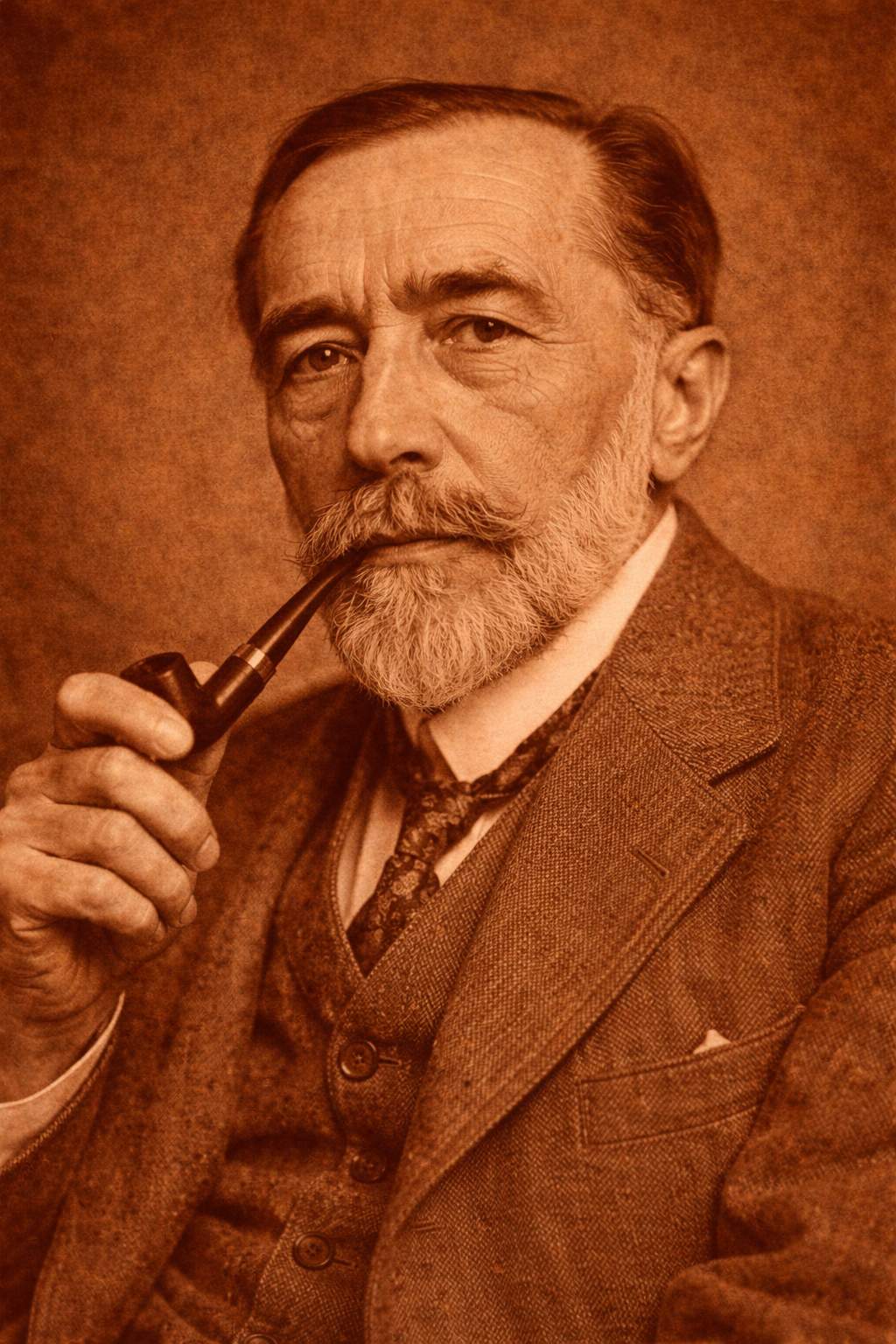
Joseph Conrad
Biography
Joseph Conrad (1857–1924), born Józef Teodor Konrad Korzeniowski in Berdychiv, then part of the Russian Empire (present-day Ukraine), was a Polish-British novelist and short story writer regarded as one of the foremost prose stylists in English literature — a language he did not begin learning until his twenties. His father, Apollo Korzeniowski, was a writer and political activist whose involvement in the Polish independence movement led to the family's exile to northern Russia, where both of Conrad's parents died during his childhood. At sixteen, Conrad left Poland for Marseille to pursue a career at sea. He spent the next twenty years in the merchant marine, eventually obtaining British citizenship in 1886 and his master mariner's certificate the same year. His seafaring experiences across Southeast Asia, Africa, South America, and the Caribbean provided the raw material for much of his fiction. Conrad's first novel, Almayer's Folly, appeared in 1895. His early works, including An Outcast of the Islands (1896) and The Nigger of the 'Narcissus' (1897), established his reputation for vivid maritime settings and psychological depth. The novella Heart of Darkness (1899), based partly on his experience commanding a steamboat on the Congo River, became one of the most widely studied texts in English literature for its exploration of imperialism, moral ambiguity, and the limits of European civilization. Lord Jim (1900) further demonstrated Conrad's narrative sophistication through its fragmented chronology and multiple narrators. Nostromo (1904), set in the fictional South American republic of Costaguana, is often cited as his most ambitious work for its panoramic treatment of politics, economics, and revolution. The Secret Agent (1907) and Under Western Eyes (1911) addressed political radicalism and espionage in urban European settings. Conrad's prose style is characterized by elaborate sentence structures, layered narrative frames, and sustained attention to moral complexity. His use of unreliable narrators and non-linear storytelling anticipated later developments in modernist fiction. He continued writing until shortly before his death at his home in Bishopsbourne, Kent, in August 1924.
Common themes in Joseph Conrad's work
Imperialism and colonialism
A recurring theme throughout Joseph Conrad's writing.
Moral ambiguity and ethical choices
A recurring theme throughout Joseph Conrad's writing.
The darkness within humanity
A recurring theme throughout Joseph Conrad's writing.
Isolation and alienation
A recurring theme throughout Joseph Conrad's writing.
Books
Lord Jim
The Shadow Line
A Personal Record

Under Western Eyes
The Nigger of the Narcissus
The End of the Tether

An Outcast of the Islands
Romance

Heart of Darkness
The Mirror of the Sea
The Secret Agent

Almayer’s Folly
The Inheritors

Nostromo

Victory
Explore by genre
Other authors you may enjoy
Why Joseph Conrad is still read today
Joseph Conrad (1857-1924) remains one of the most influential figures in modern English literature, despite English being his third language after Polish and French. His exploration of imperialism, moral ambiguity, and the darkness within the human psyche in works like "Heart of Darkness" has shaped how we understand colonialism and continues to be essential reading in discussions of postcolonial literature. Conrad's narrative innovations—unreliable narrators, fragmented chronology, and impressionistic prose—influenced modernist writers from Virginia Woolf to William Faulkner. His prescient portrayal of terrorism in "The Secret Agent" feels eerily contemporary, while his seafaring tales capture the isolation and moral tests faced by individuals far from society's constraints. Conrad's work challenges readers to confront uncomfortable truths about civilization, power, and human nature.
Frequently Asked Questions
Why is Joseph Conrad considered important in English literature?
Conrad revolutionized English prose style with his impressionistic technique and complex narrative structures. His exploration of imperialism, particularly in "Heart of Darkness," established frameworks still used to analyze colonialism and power.
What language did Joseph Conrad write in?
Conrad wrote in English, which was his third language after Polish (his native tongue) and French. He didn't become fluent in English until his twenties, making his mastery of the language remarkable.
What are Joseph Conrad's most famous works?
His most celebrated works include "Heart of Darkness," "Lord Jim," "Nostromo," "The Secret Agent," and "Victory." "Heart of Darkness" is particularly influential and inspired Francis Ford Coppola's film "Apocalypse Now."
What themes does Joseph Conrad explore?
Conrad's major themes include imperialism and its moral costs, the darkness within human nature, isolation and moral testing at sea, the gap between civilization and savagery, and the corrupting influence of power.
Was Joseph Conrad a sailor?
Yes, Conrad spent twenty years as a merchant seaman, eventually becoming a British ship captain. His maritime experiences directly informed his fiction, providing authentic detail and philosophical depth to his sea narratives.
Essential cookies keep you signed in and save your reading progress. Analytics cookies help us understand how the site is used. You can reject analytics — we still work without them. Learn more in our Privacy Policy.