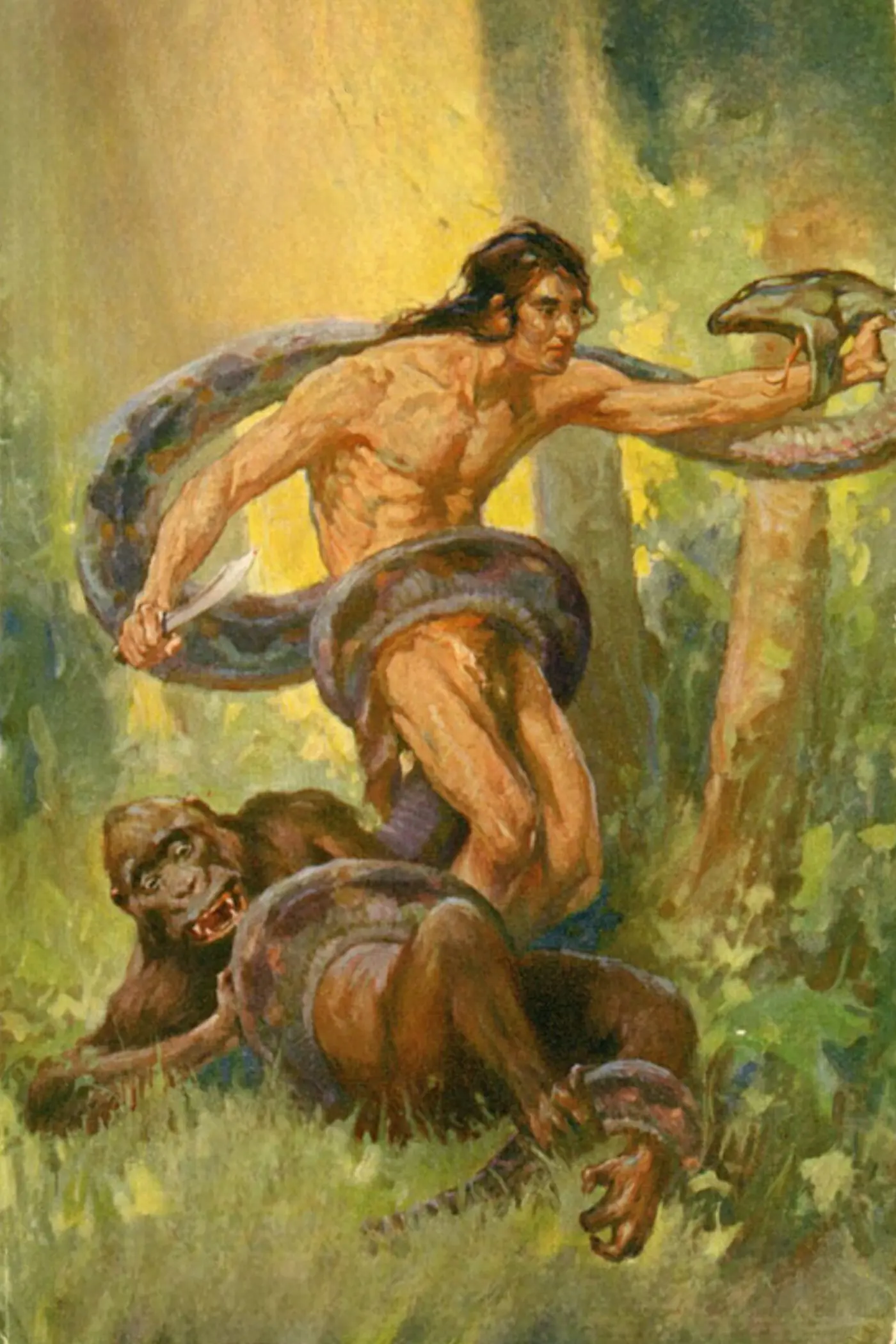
Tarzan, Lord of the Jungle
What is Tarzan, Lord of the Jungle about?
Tarzan, Lord of the Jungle, published in 1928, is the eleventh novel in Edgar Rice Burroughs's Tarzan series. An American explorer, James Hunter Blake, becomes lost in the African interior and stumbles upon the hidden Valley of the Sepulcher, inhabited by descendants of medieval Crusaders who have preserved their feudal way of life for seven hundred years, completely isolated from the modern world. The valley contains two rival cities: Nimmr, whose knights follow the code of the Knights Templar, and the City of the Sepulcher, ruled by treacherous lords. Tarzan enters the valley in pursuit of Arab slavers and finds himself immersed in a world of jousting tournaments, castle sieges, and chivalric codes. He and Blake must navigate the deadly rivalry between the two cities while contending with the slavers who threaten the valley's isolation. The novel offers a unique collision between Tarzan's primal jungle world and the romanticized Middle Ages, producing some of the series' most entertaining fish-out-of-water scenarios. Tarzan, Lord of the Jungle demonstrates Burroughs's ability to blend historical adventure with his established jungle mythology.
Main themes in Tarzan, Lord of the Jungle
Medieval chivalry preserved in isolation
The presence of medieval chivalry preserved in isolation in Tarzan, Lord of the Jungle connects readers to its enduring relevance.
Culture clash between eras and worlds
The presence of culture clash between eras and worlds in Tarzan, Lord of the Jungle connects readers to its enduring relevance.
The threat of the outside world to hidden societies
Tarzan, Lord of the Jungle thoughtfully explores the threat of the outside world to hidden societies through its central conflicts.
Knightly honor versus jungle pragmatism
Knightly honor versus jungle pragmatism emerges as a defining element in Tarzan, Lord of the Jungle, shaping character development.
Why Tarzan, Lord of the Jungle is still relevant today
Tarzan, Lord of the Jungle uniquely blends the Tarzan adventure formula with medieval romance, creating a memorable lost-world scenario involving Crusader descendants. The novel explores the collision between Tarzan's primal survival skills and a preserved feudal society, producing entertaining culture-clash moments. Its premise of an isolated medieval community influenced later lost-world fiction. As a public-domain work, it appeals to readers who enjoy both jungle adventure and historical fiction, particularly tales of knights, crusaders, and chivalric codes.
More by this author
Frequently Asked Questions
What is Tarzan, Lord of the Jungle about?
Tarzan enters a hidden valley inhabited by descendants of medieval Crusaders who have lived in isolation for seven hundred years. He encounters jousting tournaments, castle sieges, and chivalric codes while fighting Arab slavers who threaten the valley.
Are there really medieval knights in this Tarzan book?
Yes, the Valley of the Sepulcher is home to descendants of Crusaders who have preserved their feudal society for centuries, complete with knights, castles, tournaments, and the code of the Knights Templar.
How does Tarzan interact with the medieval society?
Tarzans jungle skills and superhuman strength make him a formidable warrior in the medieval setting, but the cultural differences between his primal worldview and their chivalric codes create entertaining and dramatic situations.
Is this book connected to the other Tarzan novels?
While part of the series, it tells a self-contained story with a unique premise. Knowledge of previous books is helpful but not required to enjoy this adventure.