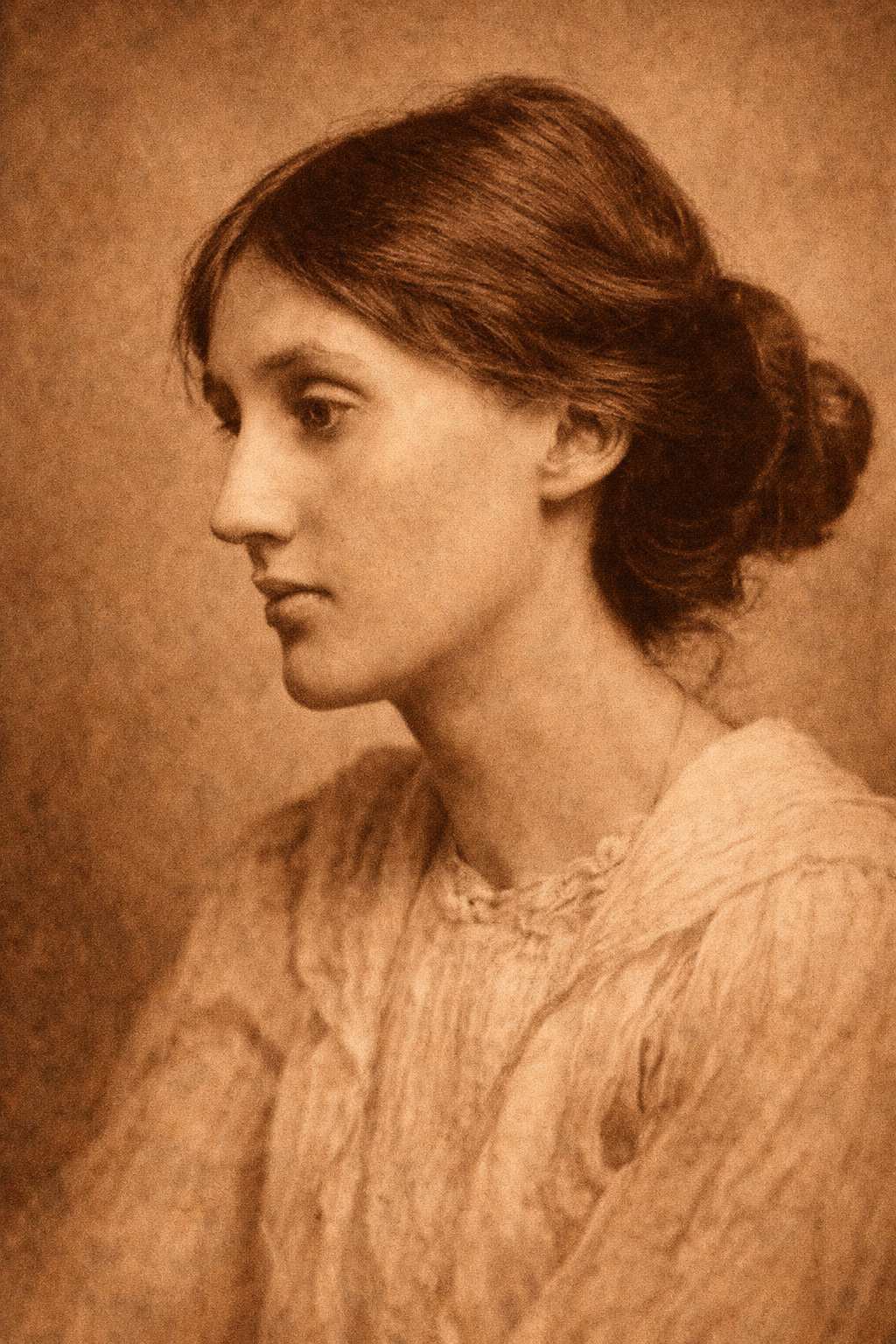
Virginia Woolf
Biography
Virginia Woolf (1882–1941) was an English novelist, essayist, and critic who played a central role in the development of modernist literature. Born Adeline Virginia Stephen in London, she grew up in a prominent literary household — her father, Leslie Stephen, was the founding editor of the Dictionary of National Biography. She was educated largely through her father's extensive library and through intellectual exchanges within her family circle, an experience that later informed her arguments about women's exclusion from formal education. Following her father's death in 1904, Woolf and her siblings relocated to the Bloomsbury district of London, forming the nucleus of the Bloomsbury Group, an influential collective of writers, artists, and intellectuals that included E.M. Forster, Lytton Strachey, John Maynard Keynes, and her husband Leonard Woolf, whom she married in 1912. In 1917, the Woolfs founded the Hogarth Press, which published works by T.S. Eliot, Katherine Mansfield, and Sigmund Freud in English translation, in addition to Virginia's own novels. Woolf's fiction is distinguished by its innovative use of interior monologue, shifting temporal perspectives, and lyrical prose that renders subjective experience with precision and complexity. Her major novels — Mrs Dalloway (1925), To the Lighthouse (1927), Orlando (1928), and The Waves (1931) — progressively dismantled conventional plot structures in favor of associative, consciousness-driven narrative forms. Mrs Dalloway, set over the course of a single day in London, interweaves multiple characters' interior lives through free indirect discourse, a technique that became foundational to the stream-of-consciousness method. Her extended essay A Room of One's Own (1929) remains an influential text in feminist literary criticism, arguing that women require financial independence and private space to produce literature. Three Guineas (1938) extended this analysis to the connections between patriarchal institutions and militarism. Woolf struggled with recurrent episodes of mental illness throughout her life and died by suicide in 1941 near her home in Sussex.
Common themes in Virginia Woolf's work
Stream of consciousness
A recurring theme throughout Virginia Woolf's writing.
Time and memory
A recurring theme throughout Virginia Woolf's writing.
Gender and identity
A recurring theme throughout Virginia Woolf's writing.
Feminist thought
A recurring theme throughout Virginia Woolf's writing.
Books
Explore by genre
Other authors you may enjoy
Why Virginia Woolf is still read today
Virginia Woolf (1882-1941) revolutionized the novel with her modernist experiments in consciousness, time, and perception. Her pioneering stream-of-consciousness technique in works like "Mrs Dalloway" and "To the Lighthouse" captured the inner life with unprecedented subtlety, influencing generations of writers. A central figure of the Bloomsbury Group, Woolf was also a brilliant essayist whose "A Room of One's Own" remains a foundational feminist text. Her exploration of gender fluidity in "Orlando" anticipated contemporary discussions, while her lyrical prose style set new standards for literary beauty. Despite—or through—her struggles with mental illness, Woolf created some of the twentieth century's most profound explorations of consciousness and memory.
Frequently Asked Questions
Why is Virginia Woolf considered so important?
Woolf pioneered stream-of-consciousness narrative, capturing the flow of thought and sensation with unprecedented subtlety. She transformed what novels could do, moving from external plot to inner experience as the main subject.
What is stream of consciousness?
A narrative technique representing the continuous flow of thoughts, feelings, and impressions in a character's mind. Woolf perfected this in Mrs Dalloway, where readers experience the characters' mental lives directly.
What was the Bloomsbury Group?
An influential circle of writers, artists, and intellectuals in early 20th-century London, including Woolf, her husband Leonard, E.M. Forster, Lytton Strachey, and others. They championed modernism and unconventional lifestyles.
What is A Room of One's Own about?
This extended essay argues that women need financial independence and private space to create art. Its famous opening—imagining Shakespeare's equally gifted sister—illustrates how society suppressed women's creativity.
How did Woolf's mental illness affect her work?
Woolf suffered from what we would now likely diagnose as bipolar disorder. Her experiences informed her sensitive portrayals of consciousness and reality, though they ultimately led to her suicide in 1941.
Essential cookies keep you signed in and save your reading progress. Analytics cookies help us understand how the site is used. You can reject analytics — we still work without them. Learn more in our Privacy Policy.