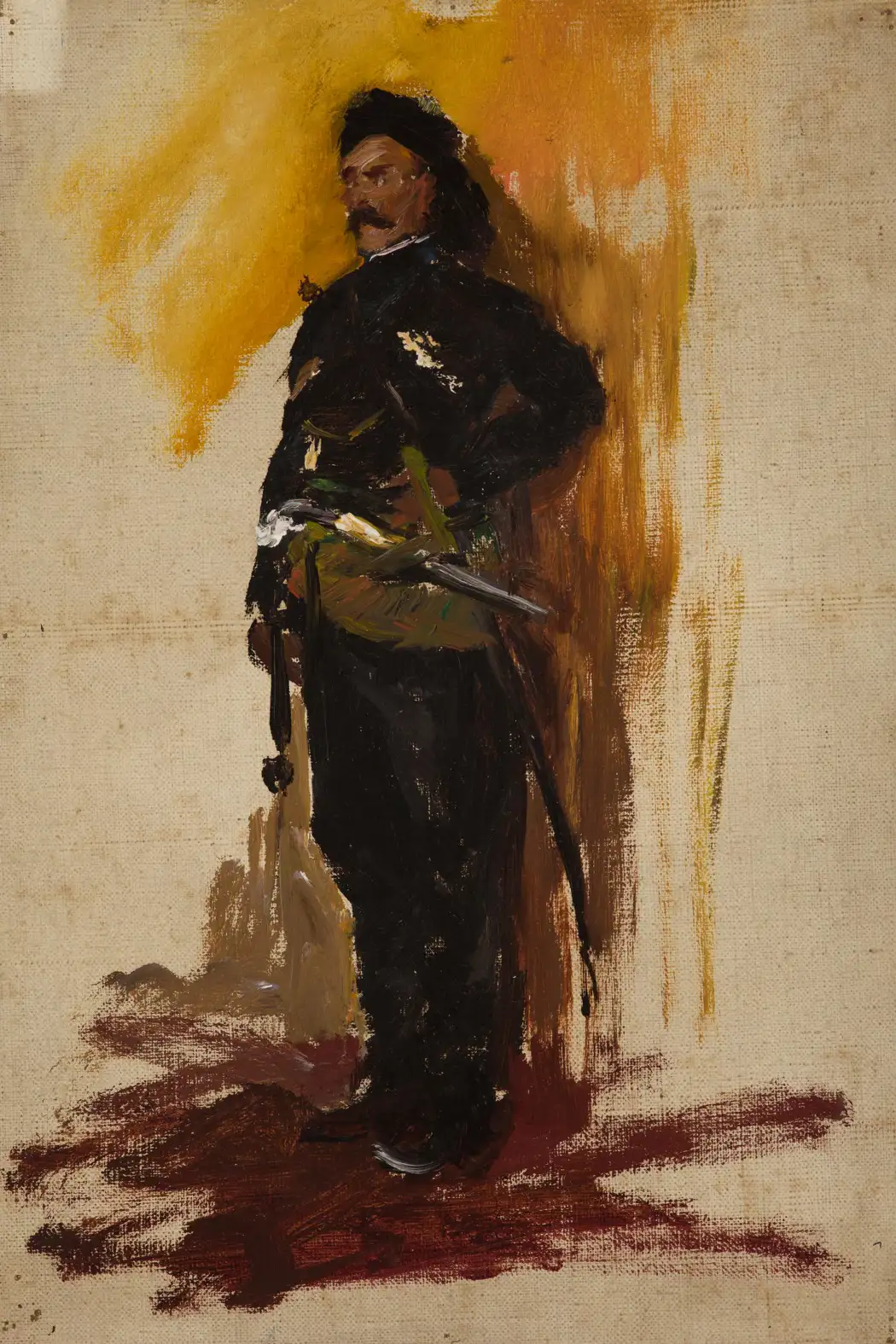
Hadji Murád
What is Hadji Murád about?
In this short novel, Tolstoy fictionalizes the final days of Hadji Murád, a legendary Avar separatist who fought against, and later with, Russia, as the Russian Empire was struggling to annex Chechnya and the surrounding land in the late 1840s. The novel opens with the narrator finding a thistle crushed in a blooming field, which reminds him of Hadji Murád and his tragic tale. As the narrator recounts the story, the reader is quickly thrust into the rich, colorful history of the Caucuses, and its people’s fight against Russian imperialism. Hadji Murád is portrayed as a legendary and imposing, yet friendly and approachable figure. Despite his reputation, it seems that his best days are behind him; as the novel opens, Murád is fleeing Shamil, a powerful imam who has captured Murád’s family. Murád finds himself thrust between the invading Russians on one side, and Shamil’s vengeance on the other. As Murád and his tiny but loyal group of warriors try to forge alliances in their attempt to rescue Murád’s family, they quickly find themselves politically outclassed. The Russians are Murád’s enemies, yet only they can help him in his struggle against Shamil; and after years of losses incurred by Murád’s guerrilla tactics, the Russians would like his help but cannot trust him. Shamil, on the other hand, is a deep link to the region’s complex web of tribal blood feuds, vengeances, reprisals, and quarrels over honor. He’s one of the few powers left standing between the Russians and their control of the Caucuses, but Murád, having crossed him, can’t rescue his family from Shamil’s clutches without the help of the Russians. Murád’s impossible position, the contradiction between his legendary past and his limping, dignified, and ultimately powerless present, and the struggle against a mighty empire by a people torn by internecine conflict, form the major thematic threads of the novel. The novel was one of the last that Tolstoy finished before his death, and was only published posthumously in 1912. Tolstoy himself served in the Crimean War, and the war scenes portrayed in the novel echo his personal experiences. As the story progresses, Tolstoy characterizes various real-life historical personalities besides Hadji Murád and Shamil, including Emperor Nicholas I, Mikhail Loris-Melikov, and Count Vorontsov-Dashkov, making this a fascinating piece of historical fiction. Despite this being such a late entry in Tolstoy’s corpus, it has been highly praised by critics both contemporary and modern, with the famous critic Harold Bloom going so far as to say that Hadji Murád is “my personal touchstone for the sublime of prose fiction, to me the best story in the world, or at least the best I have ever read.”
Main themes in Hadji Murád
Caucasian war
Caucasian war emerges as a defining element in Hadji Murád, shaping character development.
Honor and betrayal
Honor and betrayal emerges as a defining element in Hadji Murád, shaping character development.
Colonial violence
In Hadji Murád, colonial violence provides a lens for understanding the story's core message.
Individual versus empire
The presence of individual versus empire in Hadji Murád connects readers to its enduring relevance.
Why Hadji Murád is still relevant today
Hadji Murád, published posthumously, is Tolstoy's final masterpiece—a taut novella about a Chechen warrior caught between Russian and rebel forces. Despite writing it in his religious period, Tolstoy returned to pure storytelling. Many consider it his most perfectly crafted work, combining moral complexity with narrative power.
More by this author
Frequently Asked Questions
What is Hadji Murád about?
The historical Chechen leader Hadji Murád defects to the Russians during the Caucasian wars, hoping to rescue his family held hostage. Caught between enemies, mistrusted by both sides, he meets his inevitable doom with dignity.
Is Hadji Murád based on a true story?
Yes, Hadji Murád was a real 19th-century Avar leader who defected to Russia and was killed trying to escape. Tolstoy researched the history and met people who knew him, creating a historically grounded narrative.
Why is Hadji Murád considered a masterpiece?
Its compressed power and moral complexity rival Tolstoy's greatest work. He neither glorifies nor condemns his protagonist, showing empire's cruelty without propaganda. Many critics consider it his most perfectly crafted narrative.
How does Hadji Murád relate to Tolstoy's late philosophy?
Despite Tolstoy's pacifist beliefs, Hadji Murád portrays a warrior sympathetically and depicts violence vividly. The novella shows Tolstoy the artist transcending Tolstoy the moralist, returning to pure storytelling power.