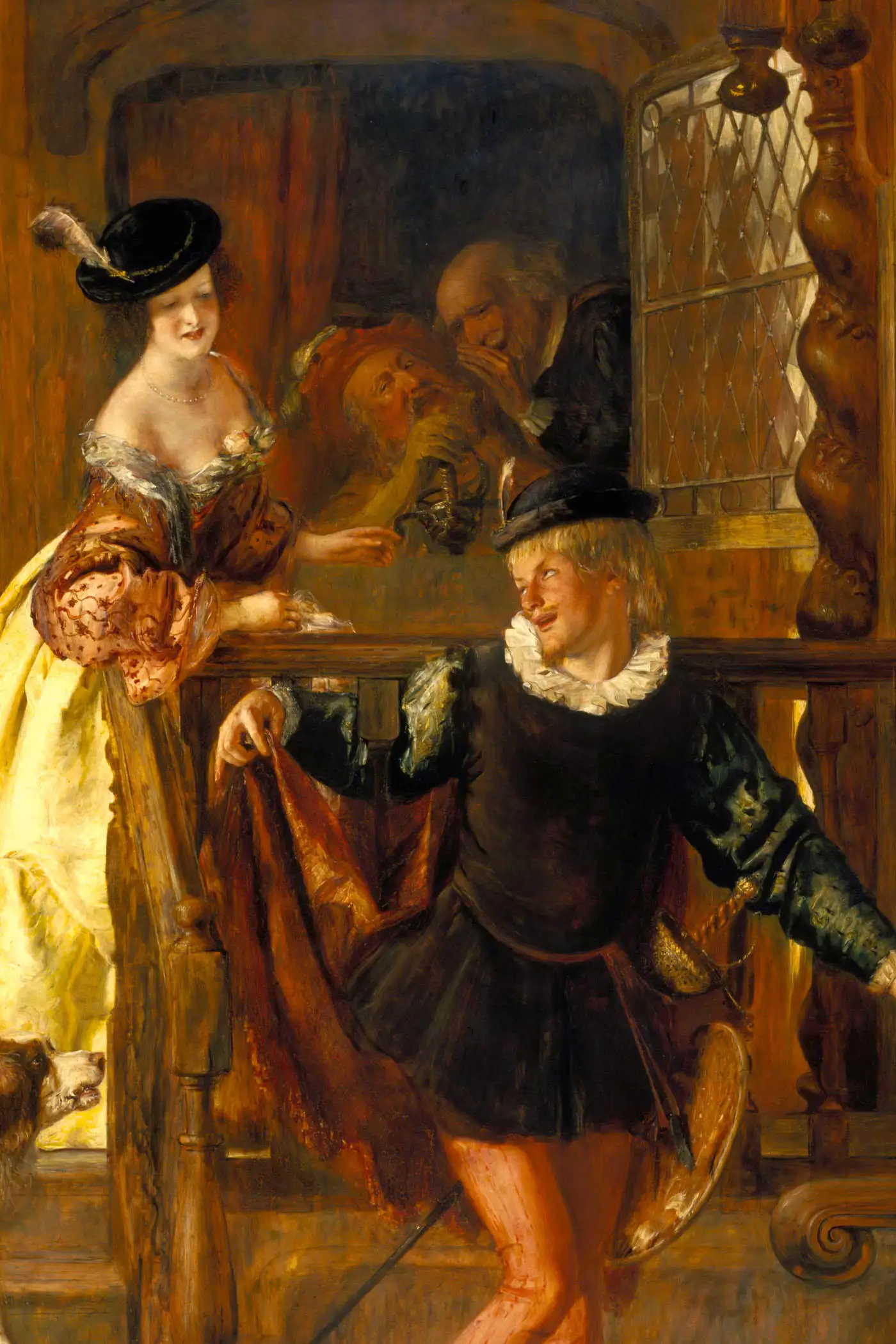
The Merry Wives of Windsor
What is The Merry Wives of Windsor about?
First published in 1602 by William Shakespeare , The Merry Wives of Windsor features the popular figure Sir John Falstaff, who first appeared in Henry IV, Part 1 and Part 2 . Some speculate that Merry Wives was written at the behest of Queen Elizabeth I, who wanted to see Falstaff in love; and that Shakespeare was forced to rush its creation as a result, and so it remains one of Shakespeare’s lesser-regarded plays. The play revolves around two intertwined plots: the adventures of the rogue Falstaff who plans to seduce several local wives, and the story of young Anne Page who is being wooed by prominent citizens while she has her sights set on young Fenton. The wives come together to teach Falstaff a lesson, and in the end love triumphs. The Merry Wives of Windsor is believed to have been first performed in 1597 and was subsequently published in quarto in 1602, in a second quarto in 1619, and then in the 1623 First Folio . Despite holding a lesser place in Shakespeare’s canon, it was one of the first Shakespearean plays to be performed in 1660, after the reinstatement of Charles II and theatre once again was permitted to be performed in London. This Standard Ebooks edition is based on Sir Arthur Quiller-Couch and John Dover Wilson’s 1923 Cambridge edition.
Main themes in The Merry Wives of Windsor
Marriage and fidelity
In The Merry Wives of Windsor, marriage and fidelity provides a lens for understanding the story's core message.
Middle-class virtue
The Merry Wives of Windsor thoughtfully explores middle-class virtue through its central conflicts.
Deception and wit
The presence of deception and wit in The Merry Wives of Windsor connects readers to its enduring relevance.
Gender and power
The theme of gender and power weaves through The Merry Wives of Windsor, adding depth to its narrative.
Why The Merry Wives of Windsor is still relevant today
The Merry Wives of Windsor showcases Falstaff in a middle-class comedy, the only Shakespeare play set in contemporary English town life. According to legend, Queen Elizabeth requested a play showing Falstaff in love. The wives' triumph over Falstaff's attempted seductions celebrates female wit and community solidarity, making it Shakespeare's most domestic and bourgeois comedy.
More by this author
Frequently Asked Questions
What is The Merry Wives of Windsor about?
Falstaff attempts to seduce two married women for their money, sending them identical love letters. The wives discover his scheme and conspire to humiliate him through a series of comic punishments while their husbands deal with jealousy and their daughter's suitors.
Is this the same Falstaff from Henry IV?
The same character, though some find him diminished here. Legend says Queen Elizabeth wanted to see Falstaff in love. The play may be set earlier than the histories, or may simply be comic entertainment without strict chronology.
Is The Merry Wives of Windsor a good play?
Opinions vary. Some find it slight compared to other Shakespeare comedies; others appreciate its bourgeois setting, female empowerment, and pure farcical entertainment. Verdi's opera Falstaff proves the story's theatrical vitality.
What makes the wives merry?
The "merry" wives are Mistress Page and Mistress Ford, respectable middle-class women who cleverly punish Falstaff for his presumption. Their successful scheming and solidarity make them the play's heroines.